Cars Bought for Cash vs Financing Explained
Buying a Car With Cash or Financing: What Changes?
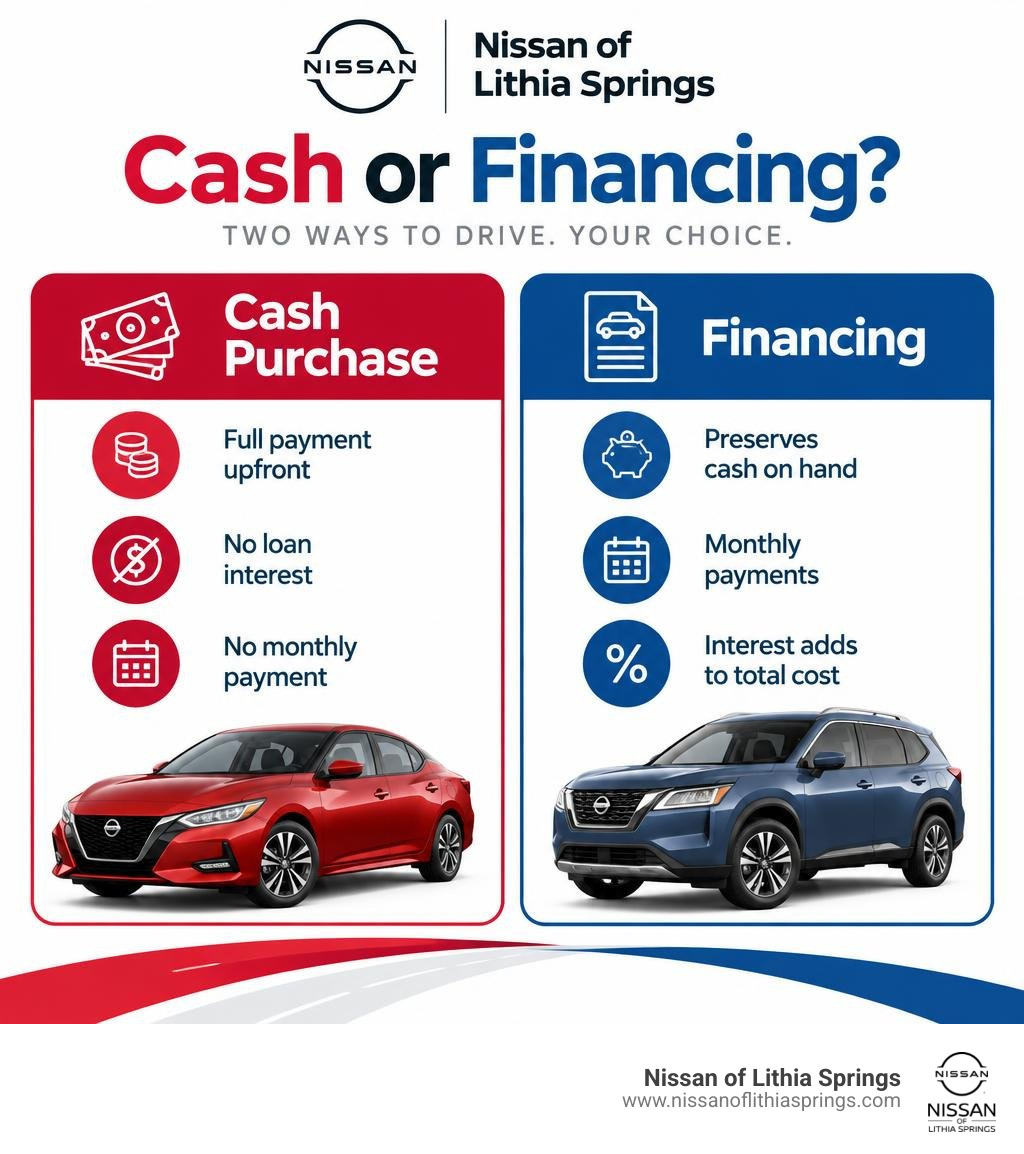
Buying a car with cash means paying the full purchase amount upfront. You avoid loan interest and monthly car payments, but use money you might need for savings or other expenses. Financing lets you spread the cost over time and keep more cash on hand, but interest can raise the total cost. Compare both options against your budget before deciding.
If you're selling your current car to help fund the purchase, a cash offer is a separate decision. Its value depends on the car's condition and market demand, and any remaining loan balance must be settled.
I'm Vaughn Smith, Marketing Director for Smith Automotive Group, which includes Nissan of Lithia Springs. My dealership experience informs how I explain cars bought for cash, trade-ins, and financing so you can weigh the practical tradeoffs.
How Cars Bought for Cash Compare to Auto Financing
Deciding whether to pay for a vehicle outright or spread payments across an auto loan involves balancing total cost against monthly liquidity. Drivers across Lithia Springs, Douglasville, and Austell navigate these decisions based on personal savings, interest rates, and household financial priorities.
| Feature | Cash Purchase | Auto Loan Financing |
|---|---|---|
| Upfront Capital Required | 100% of purchase price plus taxes and fees | Down payment and initial document fees |
| Total Interest Expense | Zero interest expense over vehicle life | Variable interest based on APR and loan duration |
| Monthly Overhead | $0 monthly loan obligations | Fixed monthly principal and interest payments |
| Vehicle Title Ownership | Outright title ownership upon transaction completion | Lien held by lender until loan payoff |
| Impact on Debt-to-Income | No impact on personal debt ratios | Adds to active debt liabilities |
| Transaction Speed | Immediate settlement with single payment | Requires application, credit verification, and approval |
When you review your budget, evaluating auto loan financing options helps clarify how interest rates and term lengths affect long-term vehicle costs compared to spending liquid reserves.
Financial Benefits of Purchasing with Full Cash
Purchasing a vehicle outright eliminates financing costs entirely. Because there is no principal balance accumulating annual interest, the total amount spent on the vehicle is strictly the agreed sale price, applicable state taxes, and registration fees.
Outright ownership provides immediate title delivery, giving owners complete flexibility over insurance coverage options beyond state-mandated liability minimums, while fully removing the risk of loan default or repossession during unexpected income disruptions.
Advantages of Traditional Auto Financing and Liquidity
Financing preserves liquid capital for emergency funds, home improvements, or long-term investments. Rather than locking tens of thousands of dollars into a depreciating asset, structured monthly payments keep personal cash reserves intact.
Taking on an auto loan also establishes positive payment history on credit profiles when payments are made consistently on time. Buyers working through private party sales can also explore an unsecured private party auto loan to act as cash buyers while retaining personal savings.
Choosing Between Cash and Financing for Your Next Vehicle
Your decision should reflect both the vehicle's total cost and your household's broader financial picture. A cash purchase works well when you have enough savings to cover the vehicle without depleting your emergency fund. Financing may be the better choice when you want to keep cash available for other priorities or when a low promotional APR reduces the cost of borrowing.
Consider the vehicle's expected ownership period as well. If you plan to keep the vehicle for many years, paying cash can maximize long-term savings. If you expect to trade or sell within a few years, financing may preserve flexibility while you build equity through payments.
For drivers evaluating a specific Nissan model, reviewing current new vehicle inventory can help you compare cash and financed purchase scenarios against real pricing.
The Process of Selling and Buying Vehicles for Cash
Whether you are looking to purchase from our used cars for sale inventory or liquidate an existing vehicle, the cash transaction process follows a straightforward verification path.
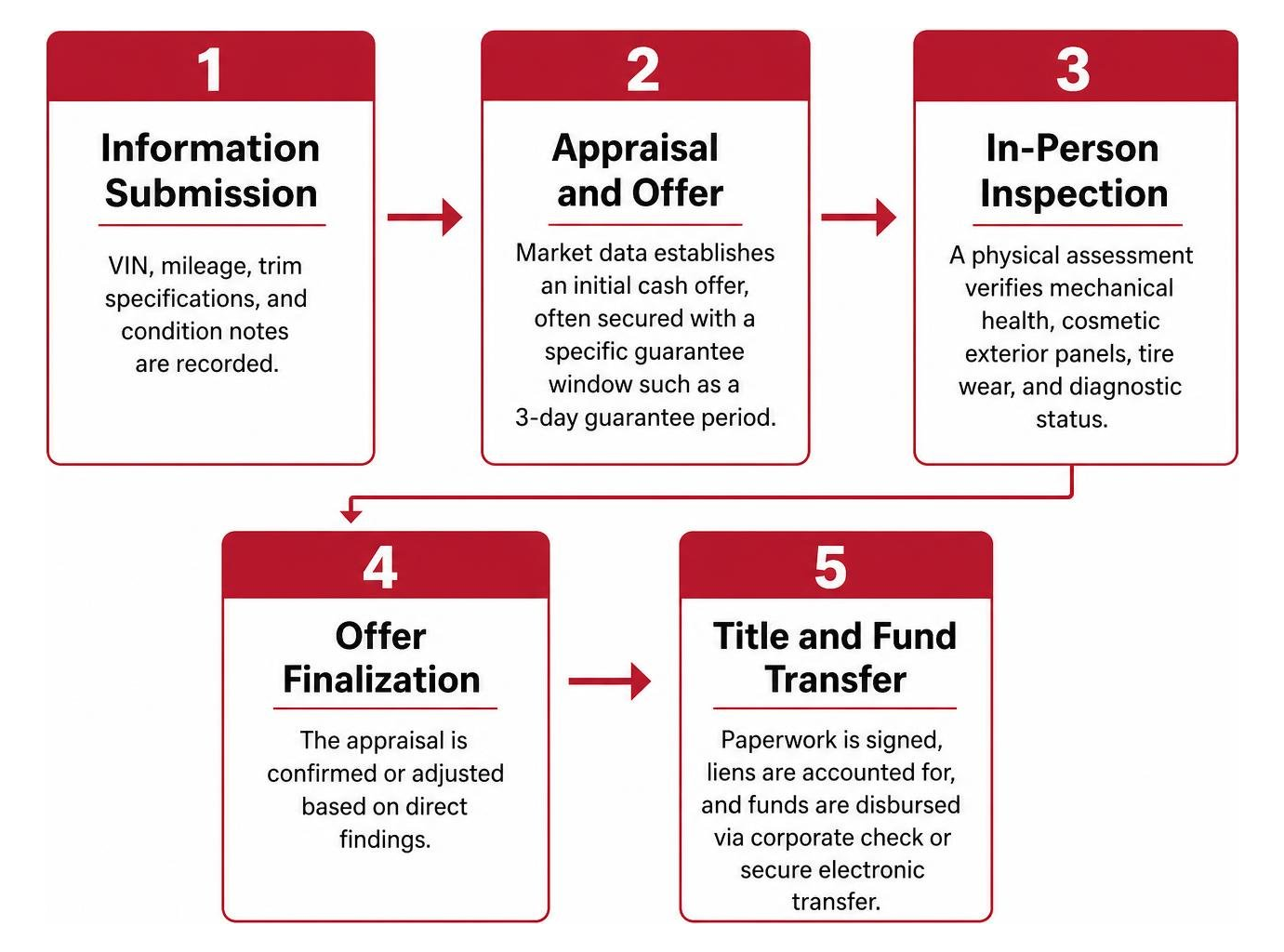
- Information Submission: The vehicle identification number (VIN), mileage, trim specifications, and condition notes are recorded.
- Appraisal and Offer: Market data establishes an initial cash offer, often secured with a specific guarantee window such as a 3-day guarantee period.
- In-Person Inspection: A physical assessment verifies mechanical health, cosmetic exterior panels, tire wear, and diagnostic status.
- Offer Finalization: The appraisal is confirmed or adjusted based on direct findings.
- Title and Fund Transfer: Paperwork is signed, liens are accounted for, and funds are disbursed via corporate check or secure electronic transfer.
Understanding How Cars Bought for Cash Are Valued
Cash appraisal figures reflect accurate wholesale and retail market indicators rather than arbitrary numbers. For owners interested in estimating vehicle market value, valuation relies on several objective factors:
- Mileage and Age: Lower odometer readings align with lower mechanical wear and higher market demand.
- Mechanical and Structural Condition: Engine health, transmission performance, suspension integrity, and fluid status directly dictate reconditioning costs.
- Vehicle History: Clean titles command higher valuation than vehicles with accident history, structural damage, or open safety recalls.
- Regional Market Demand: Compact sedans, all-wheel drive SUVs, and midsize pickup trucks like the Nissan Frontier have strong utility demand throughout Douglas County and west Atlanta.
Documentation and Requirements for Cars Bought for Cash
To complete an outright cash sale or vehicle acquisition smoothly, prepare the following items:
- Original Vehicle Title: Must be clear of unreleased liens, or accompanied by formal lender payoff documentation.
- Valid Government-Issued Photo ID: Required for all legal owners listed on the title.
- Current Vehicle Registration: Confirms active state record matching the title.
- Lienholder Account Details: Account number and official 10-day payoff statement if an active auto loan exists.
- All Factory Keys and Remotes: Complete key sets help avoid replacement deductions during appraisal.
- Maintenance Records: Service history showing regular oil changes, brake service, and scheduled factory checkups.
What to Expect During a Dealership Cash Purchase
When you buy a vehicle with cash at a dealership, the transaction typically moves faster than a financed purchase because there is no lender approval step. After you agree on the out-the-door price, the dealership prepares a purchase agreement, collects payment, and processes title and registration paperwork.
You will still need to provide the same identification and insurance information required for any vehicle purchase. The dealership handles the title transfer and registration filing, which means you can often drive away the same day once payment clears and paperwork is complete.
Selling for Cash vs Trading In: Equity and Tax Considerations

When upgrading to another vehicle, choosing between selling outright for cash or applying equity as a trade-in directly affects your net financial outcome. In many states, trading in a vehicle reduces the taxable purchase amount of the replacement car by the value of the trade credit.
When comparing vehicle trade-in and outright sale paths, calculate how sales tax savings balance against an outright cash offer. You can test different balance scenarios and down payments using our payment calculator to see how equity affects monthly payments.
When dealing with cars bought for cash, no trade-in tax credit applies because the vehicle sale is processed independently of a replacement purchase.
How Trade-In Tax Credits Work
In Georgia, when you trade in a vehicle as part of a replacement purchase, the trade-in value is subtracted from the taxable price of the new or used vehicle. For example, if you buy a vehicle priced at $35,000 and receive a $15,000 trade-in credit, you pay sales tax only on the $20,000 difference. This can represent meaningful savings compared to selling your old vehicle separately and then buying a replacement.
An outright cash sale does not provide this tax benefit because the sale and the subsequent purchase are separate transactions. However, a cash sale may still make sense if the cash offer is high enough to offset the lost tax savings, or if you do not plan to buy another vehicle immediately.
Handling Negative Equity
If you owe more on your current vehicle than it is worth, you have negative equity. In a trade-in, the remaining loan balance can sometimes be rolled into the new loan, though this increases the amount financed and the monthly payment. In a cash sale, you must pay the difference between the sale price and the loan payoff at the time of sale to release the lien and transfer the title.
Before deciding between a cash sale and a trade-in, request a current payoff quote from your lender and compare it against the cash offer or trade-in appraisal. This gives you a clear picture of your equity position and helps you choose the path that best fits your budget.
A side-by-side comparison can make the decision easier. Start with the independent cash offer and the trade-in appraisal, then account for any remaining payoff balance and applicable tax treatment. Ask the dealership to explain each figure and review the paperwork before accepting either option. This approach keeps the decision focused on net proceeds and purchase affordability rather than on one headline number alone.
Frequently Asked Questions About Cash and Financed Car Purchases
Can I Sell a Car for Cash if I Still Have an Active Loan Balance?
Yes. The purchasing dealership or buyer contacts your lienholder to obtain an official 10-day payoff quote. If the cash offer is higher than your loan balance, the positive equity is paid directly to you once the lien is satisfied. If the balance exceeds the cash offer (negative equity), you pay the difference at the time of sale to clear the title.
How Quickly Are Funds Disbursed When a Vehicle Is Sold for Cash?
Dealership cash acquisitions typically disburse funds within 24 to 48 hours following physical inspection and title verification. Payment is generally issued via a certified commercial check or direct electronic deposit to ensure complete transaction security.
Will Dealerships Buy High-Mileage or Damaged Vehicles for Cash?
Dealerships purchase vehicles across a wide range of ages, mileages, and mechanical states. While high-mileage or cosmetic wear adjusts the overall valuation to account for wholesale auction pricing or required reconditioning, vehicles do not need to be in showroom condition to receive a valid cash offer.
Is a Cash Purchase Always Cheaper Than Financing?
Not necessarily. A cash purchase avoids interest charges, which makes it cheaper in total cost when comparing the same vehicle at the same price. However, financing may allow you to take advantage of manufacturer incentives or promotional APR offers that reduce the effective cost of borrowing. In some cases, the cash you keep by financing can earn returns elsewhere that offset the interest paid. Compare the total cost of each path, not just the monthly payment.
When comparing offers, review the out-the-door purchase price, the loan term, the financing charges, and any conditions tied to incentives. A lower monthly payment can result from a longer repayment period, which may increase the total amount paid over time. If a promotional rate or incentive is available, confirm its current terms and eligibility before relying on it in your decision.
Does Paying Cash Give Me More Negotiation Leverage?
Cash can simplify a private party transaction because there is no lender approval step. At a dealership, the negotiation process is generally the same whether you pay cash or finance, because the dealership receives the full purchase amount either way. The more important factors are the vehicle's market value, condition, and demand.
Conclusion
Choosing between cash and financing comes down to balancing debt elimination against cash reserve preservation. Paying cash eliminates ongoing interest, while financing maintains flexible capital for household investments and emergency needs.
If you are looking to sell an existing vehicle outright, verify your current title status, collect your service documentation, and obtain a certified appraisal. You can sell your car for cash or value your trade at Nissan of Lithia Springs today, schedule an in-person vehicle appraisal, or explore our reliable lineup of new and pre-owned vehicles.
For drivers who want to compare cash and financing scenarios against real inventory, browse our new Nissan models or used cars for sale to see current pricing and available configurations. Our team can walk you through the numbers for both paths so you can make a confident decision based on your budget and ownership goals.