A Practical Guide to Comparing New vs Used Cars
How to Choose Between New and Used Cars
Choose a new car if you want the latest available features and full factory warranty coverage. Choose a used car if a lower upfront cost matters more and you are comfortable checking its history and condition.
Compare both by looking beyond the asking price: include financing, insurance, fuel, maintenance, and likely repairs. Then test-drive the vehicles that fit your needs before deciding.
I’m Vaughn Smith, Marketing Director for Smith Automotive Group, which includes Nissan of Lithia Springs. My dealership experience and work with car-shopping data help me explain the practical tradeoffs between new and used cars.
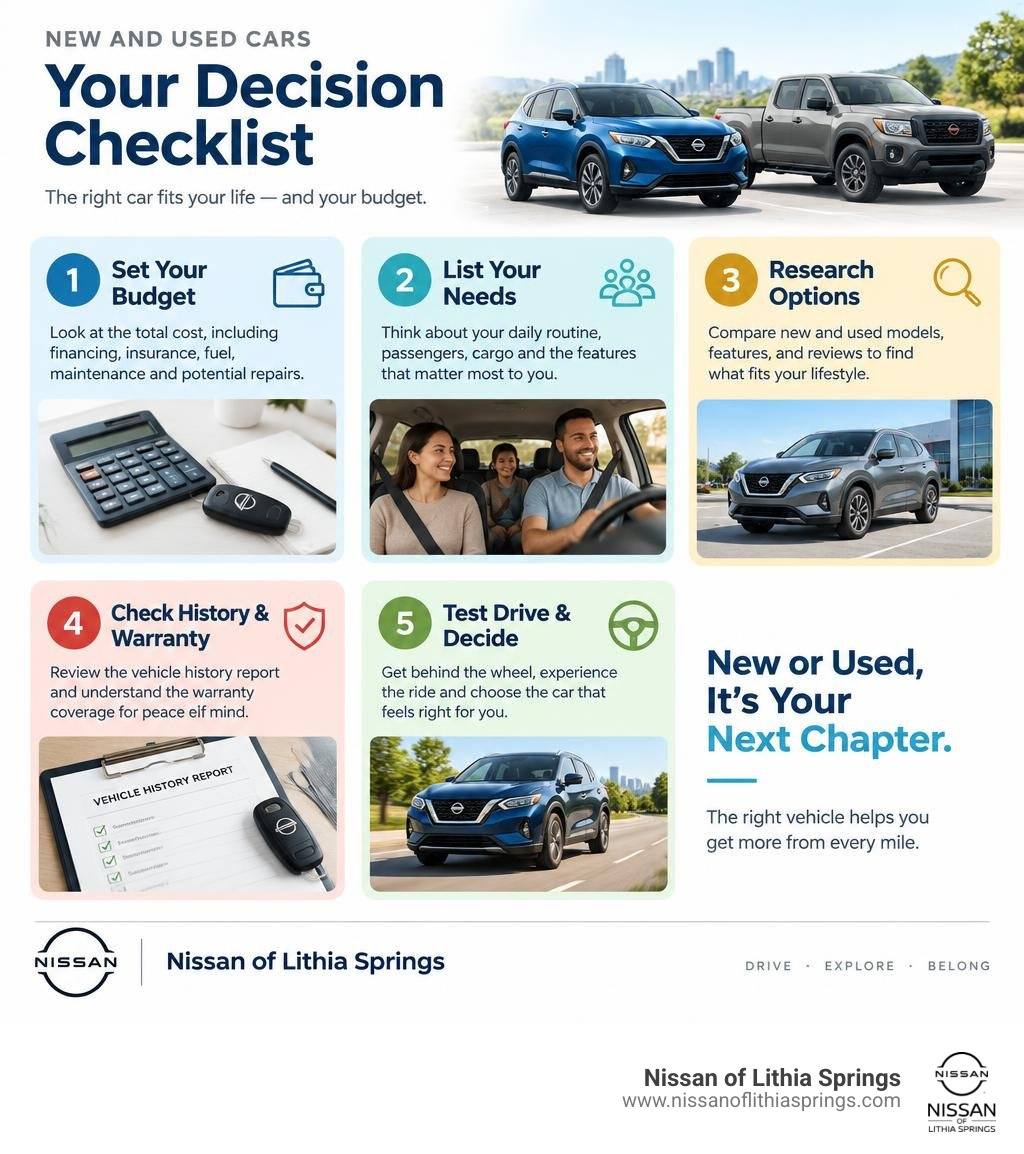
Purchasing a vehicle is one of the most significant financial commitments most households make. In October 2026, car shoppers face an evolving automotive market shaped by advances in driver-assist technologies, shifting powertrain options, and diverse financing structures. Whether you are commuting along I-20 into downtown Atlanta, managing family schedules across Douglasville and Lithia Springs, or hauling tools to a job site in Austell, choosing the right vehicle requires a clear understanding of your priorities and total ownership costs.
Key Tradeoffs Between New and Used Cars
Deciding between a factory-fresh model and a pre-owned vehicle comes down to balancing financial predictability against upfront purchase price. A brand-new vehicle provides complete transparency regarding its past, zero prior wear, and comprehensive manufacturer warranty protection. Conversely, pre-owned models offer substantial purchase price savings because the original owner absorbed the steepest portion of the depreciation curve.
When evaluating our new vehicle inventory alongside our broad pre-owned selection, it helps to categorize your options into three distinct tiers: brand new, manufacturer-certified pre-owned, and traditional used vehicles.
| Purchase Criteria | New Vehicles | Certified Pre-Owned (CPO) | Traditional Used Vehicles |
|---|---|---|---|
| Initial Purchase Price | Highest | Moderate | Lowest |
| Early Depreciation | Steepest in years 1–3 | Significantly reduced | Minimal remaining steep drop |
| Factory Warranty | Full original manufacturer terms | Extended manufacturer-backed warranty | Remainder of factory warranty (if any) or as-is |
| Vehicle History | Zero previous owners or wear | Verified clean title, strict age/mileage limits | Varies; requires thorough history check |
| Financing Rates | Often eligible for promotional rates | Competitive manufacturer programs | Standard market interest rates |
| In-Cabin Tech & Safety | Latest standard equipment | Modern, recent model-year features | Dependent on specific model year and trim |
Upfront Pricing and Value Retention in New and Used Cars
Depreciation represents the single largest hidden cost of vehicle ownership. A new vehicle typically experiences its most pronounced valuation decline during its first three years on the road. For buyers who plan to trade in their vehicle every two to three years, this initial drop can lead to negative equity if the loan balance exceeds the vehicle's market value.
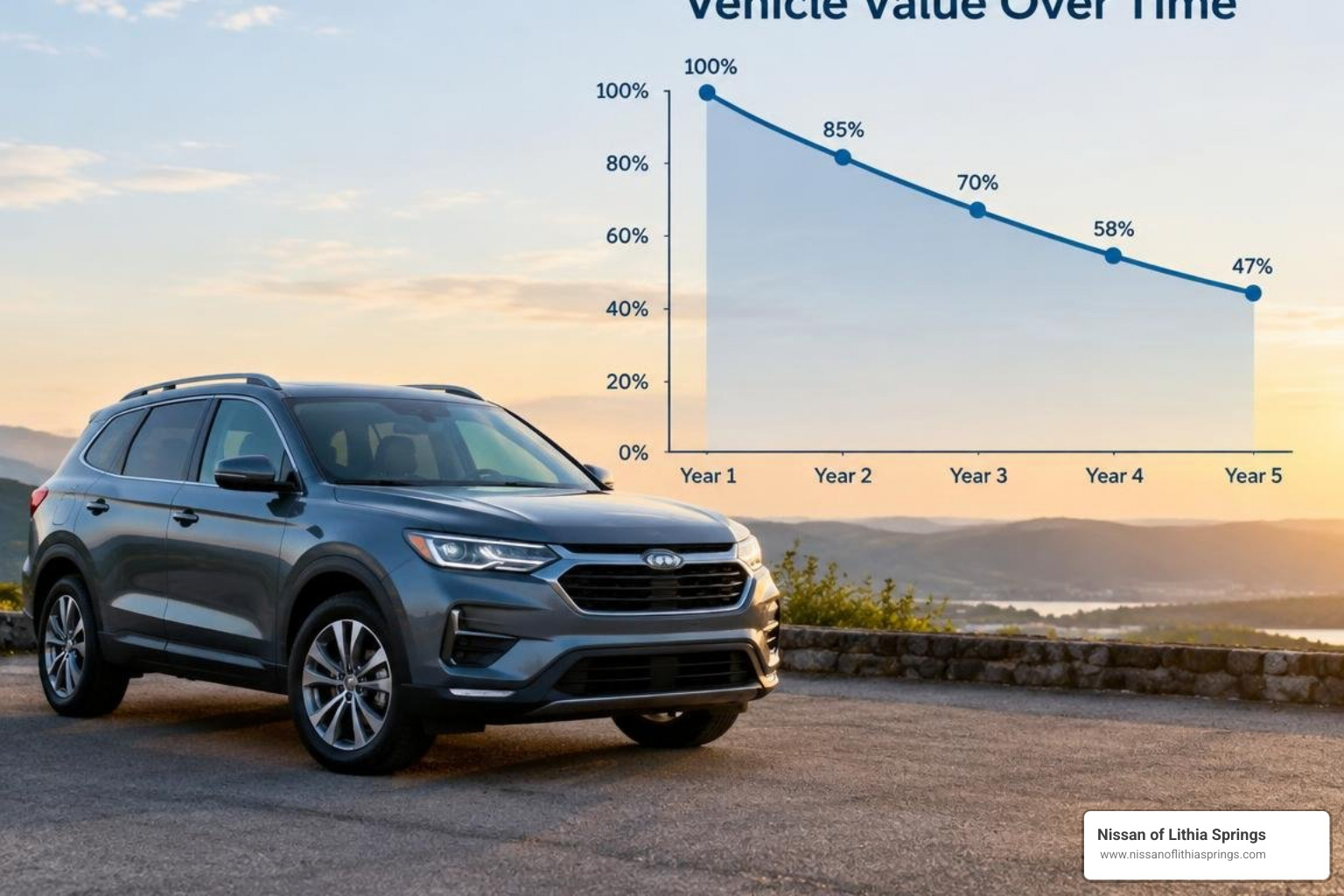
For budget-conscious shoppers in Douglas County, exploring budget-friendly vehicles under $20,000 allows you to bypass that steep early depreciation drop entirely. If your goal is long-term value retention and you keep your vehicle for seven to ten years, purchasing new spreads that initial depreciation over a long timeline, making the peace of mind of a clean history well worth the investment.
Modern Safety Features and In-Cabin Technology
Automotive technology evolves rapidly. Newer model years integrate refined driver-assistance systems such as automatic emergency braking, rear cross-traffic alert, blind-spot monitoring, and lane-keeping assistance. While these driver-assist systems provide valuable support during heavy traffic on Thornton Road or wet highway commutes, they are convenience and safety aids—they do not replace attentive driving or provide autonomous operation.
Furthermore, new models feature the latest hardware revisions for seamless smartphone connectivity, larger infotainment displays, and enhanced crash-test structures. If having the newest active safety systems standard is non-negotiable for your family, new models or late-model pre-owned vehicles provide a distinct advantage.
Financial Considerations: Financing, Leasing, and Ownership Costs
Evaluating new and used cars requires looking past the monthly payment on a dealership quote. Insurance premiums, annual registration, routine maintenance, and fuel consumption collectively determine whether a vehicle fits your household budget. You can also use official sources such as the EPA's fuel economy website and the National Highway Traffic Safety Administration for independent vehicle data.
Financing and Leasing Rates for New and Used Cars
Interest rates differ between new and pre-owned purchases. Automakers and franchise dealerships frequently offer promotional annual percentage rates (APR) on new inventory, which can offset a portion of the higher purchase price.
- New Car Financing: Access to factory-backed promotional interest rates and flexible loan terms.
- New Car Leasing: Lower monthly payments during a two-to-three-year term under full warranty coverage, but subject to mileage caps and no long-term equity.
- Used Car Financing: Higher standard interest rates from lenders due to perceived secondary-market risk, though the overall loan principal is much smaller.
Extending a used car loan beyond 60 or 72 months to achieve a lower payment can lead to paying excessive interest on an aging asset. Keeping terms shorter on pre-owned purchases is generally the most cost-effective approach.
Calculating Total Cost of Ownership
To accurately forecast five-year operating expenses, consider the following variables:
- Scheduled Maintenance: New vehicles require only routine oil changes, tire rotations, and filter replacements early on. Older vehicles eventually require wear items such as brake pads, rotors, drive belts, and fluid flushes.
- Insurance Rates: Used cars generally cost less to insure because replacement values are lower, though modern safety equipment on new vehicles can earn specific policy discounts.
- Fuel and Energy: Advancements in internal combustion efficiency and hybrid powertrains mean newer vehicles often deliver superior miles per gallon.
Service Disclaimer: This guide is provided for informational purposes only. Vehicle maintenance, diagnostics, and repairs should always be completed by a certified Nissan technician. Please consult our service department and your vehicle owner's manual before conducting any repairs.
Vehicle Assurance: Factory Warranties vs Certified Pre-Owned
Warranty protection provides essential financial insulation against unexpected mechanical repairs. A new vehicle includes standard bumper-to-bumper limited coverage and a dedicated powertrain warranty directly from the factory.

For drivers seeking pre-owned value with factory-backed confidence, our certified pre-owned inventory bridges the gap through structured, multi-point reconditioning.
Understanding Multi-Tiered Certification Programs
Not all pre-owned vehicles are created equal. As a franchised dealership, our fully Nissan-trained and certified technicians perform multi-point inspections every day, categorizing inventory to meet specific ownership expectations:
- Nissan Certified: Applicable to qualifying Nissan models up to 6 years old with fewer than 80,000 miles. Includes a comprehensive 167-point inspection, a 7-year/100,000-mile limited powertrain warranty from the original in-service date, and 24/7 roadside assistance.
- Certified Select: Encompasses qualifying Nissan and non-Nissan vehicles up to 10 years old with up to 100,000 miles. Requires an 84-point inspection and includes a 6-month/6,000-mile limited warranty alongside roadside coverage.
- EV Certified: Specifically designed for fully electric models, adding specialized battery health and high-voltage system checks to the 139-point inspection process.
- Traditional Pre-Owned: Thoroughly inspected for roadworthiness and safety, offered at our most accessible price points, but without extended factory-backed warranty coverage.
Pre-Owned History and Condition Verification
When shopping for standard used vehicles, verifying historical data is crucial. A comprehensive vehicle history report confirms title status (ensuring no salvage or flood branding), tracks previous ownership, identifies documented maintenance intervals, and discloses prior collision structural repairs.
Powertrain Selection: Modern Hybrids, EVs, and Internal Combustion
Powertrain choices have expanded significantly. When weighing your next vehicle, matching the engine or motor type to your daily driving routine in west Atlanta is vital for long-term satisfaction.
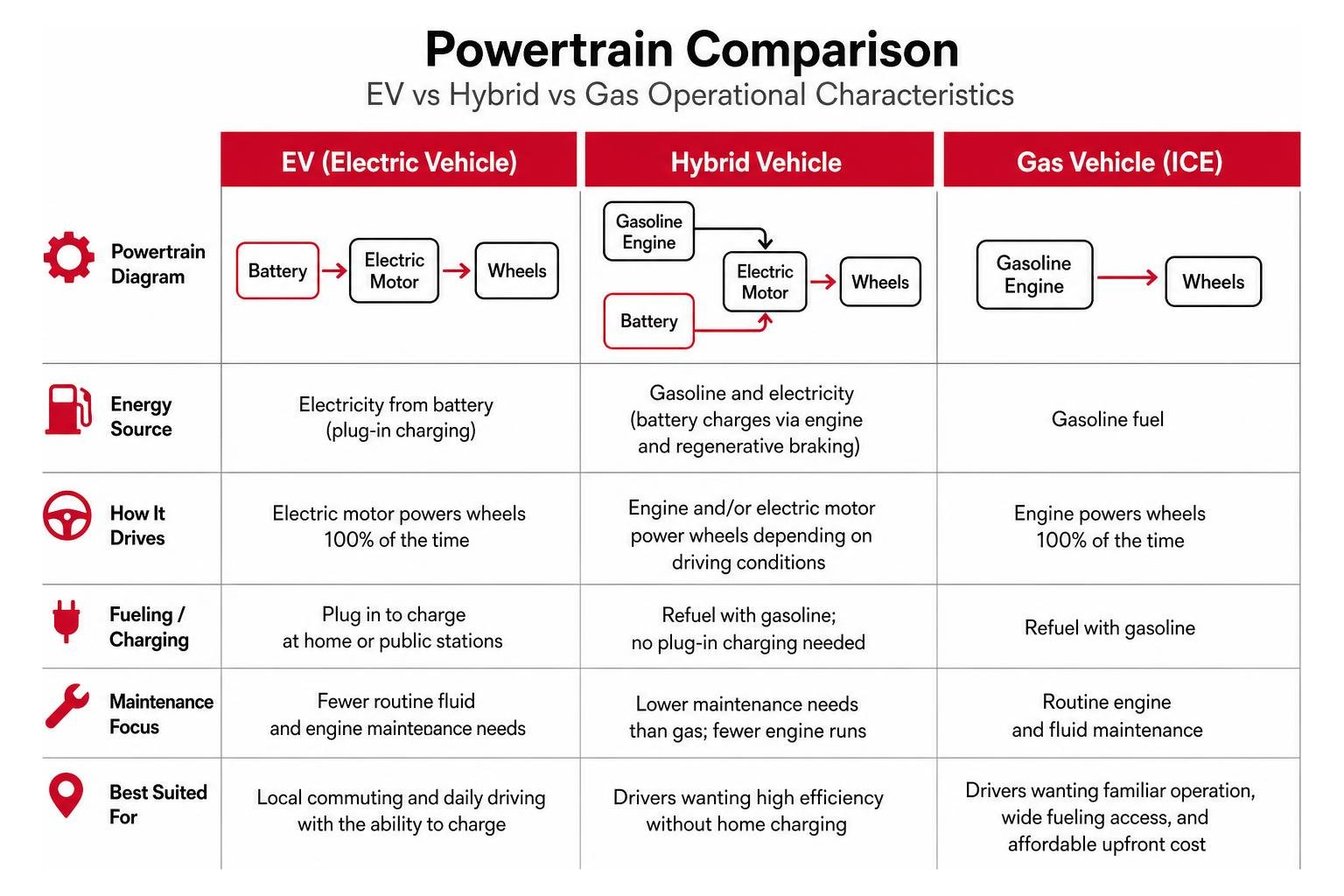
Evaluating Gas vs Electrified Models
- Pure Electric Vehicles (EVs): Ideal for local commuting throughout Mableton, Austell, and Atlanta. Commuters can recharge overnight at home, reducing routine fluid maintenance. Check our available electric vehicles if low operating cost per mile is your top objective. Regulatory standards, such as California's Advanced Clean Cars II framework adopted in 2022 aiming for zero-emission passenger car targets by model year 2035, continue to accelerate nationwide EV infrastructure and model availability.
- Hybrid Vehicles: Perfect for drivers without dedicated home charging equipment who desire outstanding fuel efficiency in stop-and-go metro traffic. Explore our hybrid models for smooth gas-electric transitions.
- Internal Combustion Engines (ICE): Standard gasoline engines provide familiar, straightforward maintenance, extensive fueling access, and strong initial purchase affordability.
Drivetrain Options for Daily Driving and Towing
Selecting the right drivetrain ensures you have appropriate traction and utility without paying for capability you do not need:
- Front-Wheel Drive (FWD): Delivers excellent fuel efficiency and dependable traction for daily suburban commuting.
- All-Wheel Drive (AWD): Automatically distributes power between the front and rear axles to enhance grip during wet or slippery road conditions. AWD does not alter vehicle braking distance or eliminate traction limits on wet roads.
- Four-Wheel Drive (4WD): Features selectable high and low ranges designed for genuine truck utility, towing heavy loads, and managing unpaved terrain.
When selecting a midsize truck like the Nissan Frontier, pay close attention to cab configurations, bed lengths, and equipment packages. Maximum advertised towing capacities require specific trim levels, hitches, and factory-installed tow packages; gross vehicle weight ratings (GVWR), tongue weight, and bed payload must be calculated based on the exact vehicle and passenger load.
Practical Steps for Research, Inspection, and Market Verification
Smart vehicle shopping combines digital research with hands-on evaluation. Review our online car shopping guide for proven strategies to compare inventory efficiently, and use official resources such as the National Highway Traffic Safety Administration's vehicle safety ratings and the EPA's fuel economy database for independent market verification.
Pre-Purchase Inspection and Diagnostic Checks
Before signing paperwork on any used vehicle, perform a structured visual and mechanical review:
- Fluid Inspection: Check engine oil, transmission fluid, and coolant for appropriate levels, clarity, and absence of burning smells.
- Brake and Tire Condition: Verify that brake rotors are smooth without deep grooving, and measure tire tread depth evenly across all four tires.
- Diagnostic Scans: Ensure the check-engine light illuminates during accessory startup and turns off once the engine runs.
- Body and Undercarriage: Inspect body panel gaps for consistency and check underneath the vehicle for fluid leaks or corrosion.
Test-Drive Best Practices
Always test-drive the vehicle on roads that mirror your daily driving routine. Pay attention to how the vehicle behaves from a cold start.
- Engine & Transmission: Listen for unusual valve noise at idle. Accelerate smoothly up to highway speeds on I-20 to verify seamless gear shifts without hesitation or shuddering.
- Steering & Alignment: Confirm the vehicle tracks straight on level pavement and that the steering wheel remains centered.
- Suspension & Cabin Noise: Drive over surface irregularities to check for rattles, worn strut clunks, or excessive wind noise.
- Braking Feel: Apply firm braking pressure to ensure the pedal feels solid and the vehicle stops smoothly without pulling to one side.
Frequently Asked Questions About Car Buying
How many miles is too many for a pre-owned vehicle?
Modern engineering allows well-maintained engines and transmissions to operate reliably well beyond 100,000 miles. Rather than focusing solely on the odometer, prioritize a documented service history. A vehicle with 75,000 highway miles and regular oil changes is often a better purchase than a 40,000-mile vehicle with neglected fluids and skipped maintenance.
What are the main benefits of buying certified pre-owned over standard used?
Certified Pre-Owned vehicles provide manufacturer-backed warranty extensions, roadside assistance, and strict vehicle eligibility limits regarding age and mileage. Each vehicle must pass a detailed multi-point inspection performed by factory-trained technicians, ensuring worn wear items are reconditioned before sale.
Is leasing a new model better than financing a pre-owned vehicle?
Leasing suits drivers who want lower monthly payments, desire new technology every two to three years, and drive predictable annual mileage under full warranty protection. Financing a pre-owned model is preferable if you plan to keep the vehicle long-term, drive high annual mileage, or want to build equity free of lease-end wear obligations.
Conclusion
Choosing between a new and used car comes down to your personal balance of upfront budget, monthly predictability, and preferred technology. New vehicles offer untouched mechanical components, full factory warranties, and the latest safety features. Pre-owned and Certified Pre-Owned vehicles deliver outstanding financial value by sidestepping early depreciation curves while still providing dependable transportation.
At Nissan of Lithia Springs, our single franchise location is dedicated to serving drivers across Lithia Springs, Douglasville, Austell, Mableton, and Powder Springs with honest expertise and practical ownership support. Whether you are looking for a versatile family SUV, an efficient commuter, or a capable midsize truck, explore quality new and used vehicles in Lithia Springs to find the right match for your everyday drive.