Nissan Altima Control Arm: Signs It May Need Professional Service
How to Spot a Nissan Altima Control Arm Problem
If your Altima clunks over bumps, wanders while steering, or wears tires unevenly, have a technician inspect its control arms, bushings, and ball joints. A damaged Nissan Altima control arm may need replacement, followed by a wheel alignment. If the car feels unstable or an arm is visibly cracked, avoid driving it and arrange an inspection.
The steps below will help you recognize warning signs and understand what happens during a repair. Nissan of Lithia Springs can inspect the suspension and help you decide what needs attention.
I'm Vaughn Smith, marketing director for Smith Automotive Group, where I work with Nissan dealership teams on service communication and the ownership experience. In this Nissan Altima control arm guide, I'll help you make sense of the symptoms and the next steps.
Disclaimer: This guide is provided for informational and educational purposes only. Vehicle maintenance, diagnosis, and suspension repairs should only be performed by certified Nissan technicians. Always consult our Nissan Service Center and your vehicle owner's manual before making maintenance decisions or authorizing repair work.
Understanding the Nissan Altima Control Arm and Common Failure Symptoms
The suspension system in your Nissan Altima is engineered to balance smooth highway cruising with responsive handling. At the heart of this system is the control arm, sometimes referred to as an A-arm or suspension link.
The control arm acts as the primary hinge connecting your vehicle's wheel assembly and steering knuckle directly to the subframe. This design allows the wheel to move vertically over bumps, dips, and road imperfections while keeping the tire firmly planted on the pavement at the correct alignment angle.
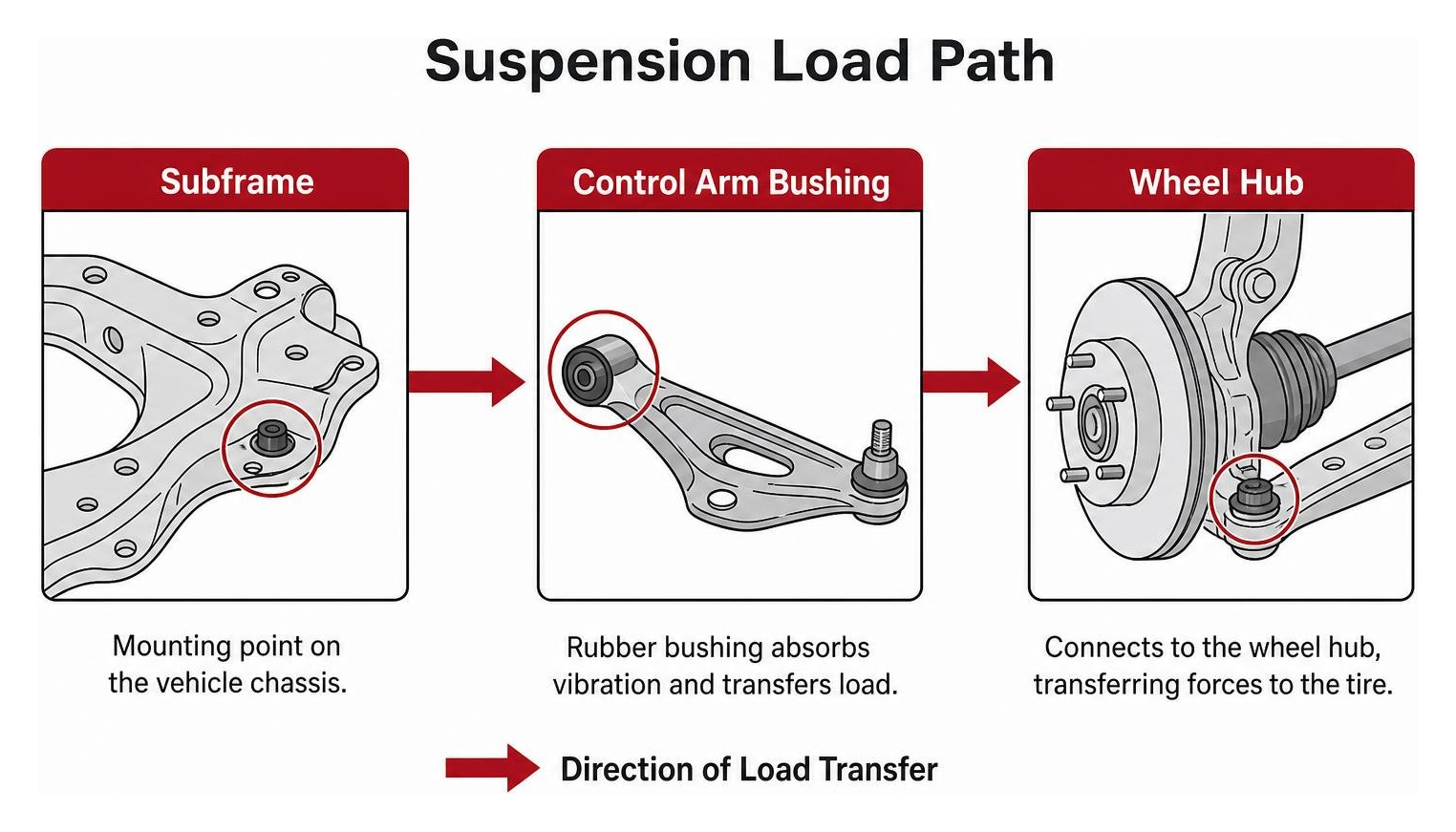
A standard control arm assembly consists of three key elements:
- The Metal Body: A stamped steel, cast iron, or forged aluminum arm designed to handle intense cornering and braking loads.
- Rubber Bushings: Flexible inserts positioned where the arm attaches to the chassis frame. They isolate cabin passengers from road vibrations and absorb lateral impacts.
- The Ball Joint: A pivoting spherical bearing connecting the outer end of the control arm to the wheel hub or steering knuckle, allowing smooth steering articulation while the suspension travels.
When these components operate in harmony, your Altima tracks straight, absorbs potholes, and maintains precise tire contact. Following a Routine Vehicle Maintenance Guide ensures these critical connection points receive regular visual checks during scheduled visits.
Symptoms of Failing Suspension Bushings and Ball Joints
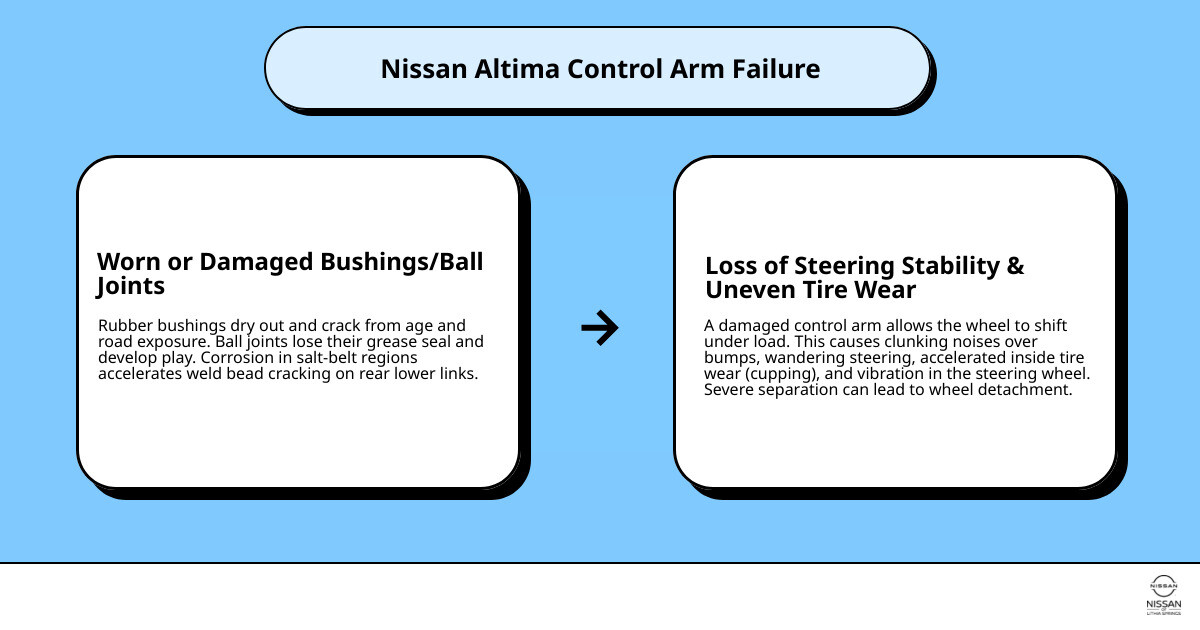
Control arm assemblies endure constant friction and road shock. Over time, internal rubber bushings dry rot, tear, or become contaminated by leaking fluids, while ball joints lose lubrication and develop excessive play.
Watch for these warning signs during your daily commute in Lithia Springs or Douglasville:
- Clunking or Popping Noises: A distinct, metallic clunk when accelerating from a stop, braking firmly, or driving over speed bumps usually indicates a torn control arm bushing or loose ball joint.
- Steering Wander and Poor Tracking: If your Altima drifts left or right on flat pavement, or if the steering feels loose and imprecise, worn bushings may be allowing the wheel assembly to shift out of its intended alignment track.
- Uneven or Accelerated Tire Wear: Excess play in a control arm alters your wheel's camber and toe settings. You may notice rapid wear along the inner or outer edges of your front or rear tires, leading to premature tire replacement.
- Steering Wheel Vibrations: Degraded rubber bushings no longer dampen road feedback effectively, transferring harsh tremors through the chassis directly into the steering wheel.
- Creaking or Squeaking at Low Speeds: Dry, deteriorated rubber pivoting against mounting bolts often produces a high-pitched squeak when turning into driveways or navigating parking lots.
Rear Lower Link Corrosion on 2013-2018 Altima Models
While front control arms endure the stresses of steering and forward braking, the rear lower suspension links on fifth-generation Altima models (2013–2018) require special attention.
In response to consumer reports, safety regulators conducted an extensive investigation, detailed in the federal ENGINEERING ANALYSIS (EA19-002) CLOSING REPORT. The analysis covered 2,038,307 vehicles, including 2013–2018 Nissan Altima and 2016–2018 Nissan Maxima sedans.
The investigation revealed that exposure to road salts and winter de-icing chemicals could lead to localized corrosion near the rear lower control arm bushing collar. In affected vehicles, this corrosion caused stress concentration and crack propagation along the original weld bead, potentially resulting in suspension link separation over extended service life. The data showed that across the subject population, the overall failure rate was approximately 0.062%, with failures occurring primarily in high-mileage vehicles averaging over 113,000 miles.
To address this issue, Nissan introduced an updated manufacturing process on January 11, 2018, incorporating a robust double bead weld that improved component durability in bench testing by more than five times.
Diagnosing Suspension Issues and Safety Risks on the Road
Properly diagnosing suspension wear requires specialized equipment and training. Because suspension components support the weight of the vehicle under high mechanical tension, visual inspections on the ground only reveal part of the story.
How to Inspect a Nissan Altima Control Arm Assembly
When you bring your vehicle to our service facility, certified technicians perform a thorough evaluation:
- Lift-Assisted Structural Inspection: Technicians raise the vehicle on a heavy-duty lift to unload the suspension. This allows them to inspect the entire length of the stamped arm, looking for hairline weld cracks, road damage, or deep corrosion.
- Bushing Integrity Checks: Using specialized pry tools, technicians apply controlled leverage against the subframe mounting brackets to check for excessive bushing deflection, torn rubber bonding, or fluid contamination from engine oil leaks.
- Ball Joint Articulation Testing: Technicians measure axial and radial movement at the steering knuckle to verify that internal ball joint tolerances remain within strict factory safety limits.
- Tire Wear Analysis: Looking at tire wear patterns can reveal suspension issues before they cause severe handling problems. Irregular cupping or feathering across the tread surface often pinpoints a worn link.
Comprehensive suspension checks are included as part of every Multi-Point Inspection Guide at our dealership, helping drivers across Austell and Powder Springs identify suspension wear before it leads to roadside trouble.
Road Safety Risks and NHTSA Dynamic Separation Testing
Driving with a compromised control arm introduces substantial safety hazards. If an arm cracks or a ball joint separates while driving, the affected wheel loses its primary structural anchor to the chassis. This can cause the wheel to shift violently within the wheel well, resulting in an abrupt loss of steering control and potential body damage.
During the federal engineering evaluation (EA19-002), safety researchers evaluated dynamic handling under simulated component failures. While standard driver-assistance features like Nissan's Vehicle Dynamic Control (VDC) assist with vehicle stability under normal operational limits, electronic systems cannot overcome physical suspension detachment or prevent loss of control if structural components separate. Replacing worn suspension links promptly ensures your vehicle retains its designed structural integrity and emergency evasive capabilities.
Suspension Link and Arm Replacement Overview
Replacing a Nissan Altima control arm is an intricate mechanical service that requires specialized shop hoists, professional bushing presses, and calibrated torque instruments. Because suspension links mount directly to the structural subframe or rear crossmember, improper installation poses serious road hazards.

When certified technicians service your Altima's suspension at an authorized dealership, they utilize factory service manuals to ensure critical safety standards:
- Component Isolation: Technicians safely support the chassis and disconnect associated stabilizer links, speed sensor harnesses, and brake line brackets without placing stress on electrical wiring or hydraulic lines.
- Controlled Fastener Removal: Specialized pullers decouple ball joint tapers without scarring steering knuckles or adjacent steering linkages.
- Ride-Height Hardware Torquing: Crucially, suspension bushing pivot bolts must be torqued while the suspension is loaded at normal curb weight rather than hanging on a lift. Tightening hardware at full droop can preload the rubber bushings, leading to rapid tearing and premature failure.
For accurate diagnosis and safe installation, contact our Nissan Service Center to schedule professional repair.
Why a Four-Wheel Alignment Is Critical After Installation
Any time a control arm, ball joint, or tie rod is serviced or replaced, your vehicle's underlying suspension geometry shifts.
Even minor dimensional variations between worn original parts and new components alter wheel angles:
- Camber Angle: The inward or outward tilt of the tire relative to vertical. Incorrect camber causes rapid wear along one side of the tire tread and impairs cornering grip.
- Caster Angle: The forward or rearward tilt of the steering axis. Improper caster creates high-speed instability and makes the steering wheel slow to return to center after turns.
- Toe Angle: The direction the tires point relative to the centerline of the vehicle. Misaligned toe scrub quickly ruins tire tread within just a few hundred miles of driving.
A complete four-wheel computerized alignment restores these angles to factory specifications, protects your tire investment, and allows technicians to recalibrate electronic steering angle sensors on equipped Altima model years.
Genuine OEM Components and Factory Replacement Options
When repairing your Altima's suspension, selecting Genuine Nissan Parts ensures long-term reliability, precise road feel, and exact factory fitment.
| Feature / Attribute | Genuine OEM Nissan Arms | Factory Standard Specifications |
|---|---|---|
| Material Build | Stamped Steel / Cast Alloy to exact factory specifications | Engineered to original structural standards |
| Bushing Type | Factory-tuned natural rubber for noise isolation | Optimized dampening for road vibrations |
| Ball Joint Design | Sealed, low-friction OE ball joint assembly | Factory-greased spherical joint |
| Fitment Accuracy | 100% precision VIN match for exact geometry | Direct bolt-on alignment |
| Warranty Protection | Backed by official Nissan parts warranty terms | Nissan dealer supported coverage |
Choosing the Right Nissan Altima Control Arm for Your Model Year
Sourcing the correct suspension part requires matching your specific model year, trim package, drivetrain (front-wheel drive vs. Intelligent All-Wheel Drive on 2019+ models), and whether you are replacing the left or right side:
- Sixth-Generation Altima (2019–Present): Models equipped with available Intelligent AWD utilize distinct rear link and subframe geometries compared to standard front-wheel-drive configurations (such as part reference family 551B0-6CC0A).
- Fifth-Generation Altima (2013–2018): Front lower control arm assemblies (such as part reference family 551B1-3TA0D) and rear lower links (such as updated double-bead weld part family 551B0-3TA0D) require precise VIN verification for exact side and suspension package fitment.
Because individual part numbers vary significantly across production runs, trim levels, and model revisions, always contact our dealership's parts department with your 17-digit Vehicle Identification Number (VIN) to verify exact component matching and current pricing.
Extended Warranty Coverage and Campaign P93240
To support owners affected by rear lower link corrosion in designated regions, Nissan launched voluntary service campaign P93240 to conduct targeted dealer inspections and install updated replacement links where applicable. In addition, Nissan provided an extended warranty covering the rear lower suspension links for 120 months (10 years) and unlimited miles on specific eligible 2013–2018 Nissan Altima and 2016–2018 Nissan Maxima vehicles, subject to individual campaign terms and vehicle history.
If you drive an Altima from these model years or are browsing our Used Nissan Altima Inventory, our service advisors can run your VIN through the Nissan warranty database to check for open campaigns, verify prior recall completion, and determine warranty coverage.
Conclusion
Maintaining healthy suspension components is essential for enjoying the dependable performance, comfortable ride, and precise handling your Nissan Altima was built to deliver. Whether you are driving an experienced Altima through Douglas County or commuting in the newest model, addressing suspension wear early protects your tires, steering components, and overall safety.
Our certified technicians at Nissan of Lithia Springs have the factory training, specialized tools, and Genuine Nissan Parts needed to diagnose and service your vehicle's suspension correctly.
Ready to restore your vehicle's smooth ride? Schedule Service with our expert team today.
Frequently Asked Questions
How do I know if my control arm or ball joint is bad?
Common signs include loud metallic clunking or knocking noises when driving over bumps, wandering steering on the highway, unusual steering wheel vibrations, and accelerated, uneven tire wear. A certified technician can lift the vehicle to test for excessive ball joint play and inspect the rubber bushings for tears or rot.
Can I safely drive with a squeaking control arm?
While a faint bushing squeak might not cause immediate failure, it signals that the rubber has aged and lost its elasticity. If left unaddressed, worn bushings allow metal-on-metal contact, accelerate tire wear, and risk sudden ball joint or weld separation. If you notice clunking, loose steering, or structural cracks, avoid driving the vehicle and schedule an inspection right away.
Is the Nissan Altima rear lower control arm covered under warranty?
Nissan provided an extended warranty on rear lower suspension links for up to 120 months with unlimited mileage for eligible 2013–2018 Nissan Altima and 2016–2018 Nissan Maxima vehicles to address specific corrosion concerns. Coverage eligibility depends on vehicle production date, campaign criteria, and prior campaign completion. Contact our service department with your 17-digit VIN to confirm your vehicle's specific warranty status.
Why does my car need a wheel alignment after control arm replacement?
Control arms directly set your vehicle's camber, caster, and toe angles. Replacing an arm or its bushings alters these angles. A computerized four-wheel alignment ensures your vehicle tracks straight, maintains proper tire contact with the road, and allows recalibration of steering angle sensors on equipped modern vehicles.
What is the difference between front and rear control arms on an Altima?
Front control arms manage steering articulation and absorb the heavy forces of forward braking and turning via integrated ball joints. Rear lower control arms, or suspension links, maintain rear track stability, control body roll, and preserve rear wheel alignment over bumps.